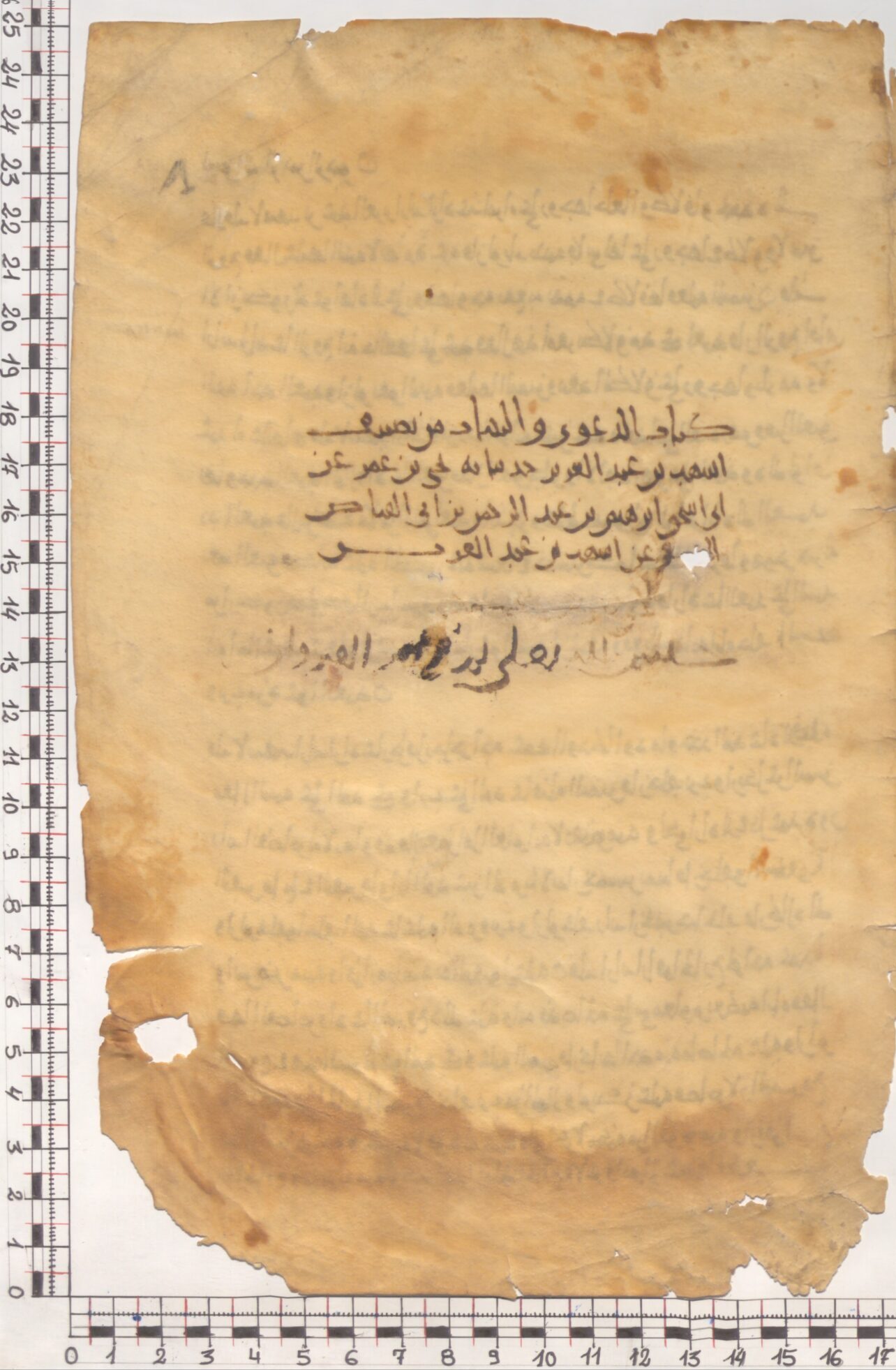
Four manuscripts from the Mālikī tradition: NLPCPM, Raqqada, 10-1648
By Jonathan Brockopp When I started my graduate program, I had no idea I would be working on Arabic manuscripts. At that point, I knew more about the manuscript tradition of Christianity and Judaism than I did the early Islamic tradition. The more I p…
When I started my graduate program, I had no idea I would be working on Arabic manuscripts. At that point, I knew more about the manuscript tradition of Christianity and Judaism than I did the early Islamic tradition. The more I pushed into Islamic history, however, the more I realized what a wealth of Arabic manuscripts was available for the early period.
I continue to be amazed that every new discovery from Qumran, or of a new Gospel, receives widespread press coverage, while very few people know of similarly important discoveries of early Islamic manuscripts. Because it is a small group, however, anyone who shows the slightest interest is welcomed. So it was that Miklos Muranyi, then professor at Bonn University, introduced me to the wonders of the early Mālikī tradition.
Muranyi died this past March, after a long illness. He had a great love of the Kairouan collection in particular, and, in some ways, his Beiträge zur Geschichte der Ḥadīt- und Rechtsgelehrsamkeit der Mālikiyya in Nordafrika bis zum 5. Jh. d.H. was written as a critical basis for a catalogue.[1] But it is just one piece of his enormous oeuvre, and I am pleased that he was able to write the Epilogue to the volume that I am co-editing with Asma Helali on Kairouan Manuscript Cultures.[2] But I am even more grateful for the many summer evenings we spent in his beautiful backyard discussing manuscripts.
Muranyi's advice was invaluable as he guided me both through the editing of manuscripts and also the politics of working in North African libraries. He could be abrupt and dismissive, but his deep erudition and commitment to the manuscripts was known and respected by all. One piece of advice he gave was to stay away from certain manuscripts that had been "claimed" by other scholars. I took his advice to heart, and when I happened across some of the manuscripts of Ashhab b. ʿAbd al-ʿAzīz (d. 204/820) in the Kairouan collection, I left them alone. Hopefully, some day they will be edited and published.
There are many reasons why Ashhab's texts are interesting. First, he was one of the four great Egyptian students of Mālik b. Anas (d. 179/795) and is known to have possessed a keen and independent mind, though Clément Salah has recently demonstrated that he still hewed closely to Mālik's teachings.[3] Second, his writings are only known through the Kairouan collection. Joseph Schacht first described the manuscript of his Kitāb al-Ḥajj with extensive notes and description.[4] Additional finds by Muranyi include a Kitāb al-Daʿwā wa'l-Bayyināt, a Kitāb al-ʿItq and the Majālis.[5]
Ashhab's manuscripts are also interesting for material studies. For example, the eighteen-folio fragment of Kitāb al-Daʿwā wa'l-Bayyināt was transmitted by Yaḥyā b. ʿUmar al-Kinānī (d. 289/902), a student of the famous Saḥnūn b. Saʿīd (d. 240/854). While the vast majority of very early manuscripts are parchment, this manuscript is paper, described by Muranyi as "rough, thick paper (kāghiḑ)...in which the asymmetrical sieve structure and bits of leftover cloth and yarn are still to be discerned."[6] I have also examined this manuscript, with its eight paper bifolios folded inside a parchment bifolio. A reader's remark is dated 273/886–7, well before Yaḥyā b. ʿUmar's death.
That remark has been the cause of some recent controversy, as Umberto Bongianino and Clément Saleh have made it one of their prime examples of how such remarks cannot be relied on for definitive dating of a manuscript.[7] The difference of opinion is a matter of a few decades–whether this manuscript was written early in Ibn al-Labbād's career while he was studying under Yaḥyā b. ʿUmar al-Kinānī or later in life. The date of 273/886–7 is then either the moment he heard it from Yaḥyā and wrote this manuscript or a later recollection.
This controversy demonstrates the many assumptions we must make when studying these ancient fragments, assumptions that may prove to be wrong. This is complicated by scholars' tendency to write in definitive and declarative sentences, when our grasp of past realities is far more tenuous than we might like to admit. Muranyi, for example, suggested that Raqqada, 10-1648 is on locally produced paper, in contrast with the fine paper found on two other early manuscripts in Kairouan, which he suggested had been imported. Closer analysis of the paper might correct this conjecture.
The first of these fine paper manuscripts is a nine-folio fragment of an Aḥkām al-Qurʾān by the famous Baghdad scholar Ismāʿīl b. Isḥāq al-Qāḍī (d. 282/895), an important representative of the Baghdad Mālikī school. Manuscripts of his writings are also unknown outside of Kairouan. This Aḥkām al-Qurʾān is in large Kūfic script on fine paper that has been beautifully restored by the staff at the national laboratory. It is located in milaff 22 under serial number 1/221 with a reader's remark dated Jumāda I, 282/895, the same year as the author's death.[8]
Muranyi also described a third paper manuscript in Kairouan, which he argued was imported paper from Spain. This is the Kitāb al-Aḥkām by al-Ḥabīb Aḥmad b. Muḥammad b. Ziyād (d. 312/925), who was a qāḍī in Cordoba, and Muranyi characterized the paper as "of a relatively high quality, the material structures are even and straight throughout. The pages are thin and finely structured. Similar writing materials of this quality are not found in the Kairouan manuscript collection until about the sixth century and later."[9]
Interestingly, the author of this Aḥkām is the son of a correspondent with Saḥnūn. An undated copy of a thirty-six-line letter from Saḥnūn to Muḥammad b. Ziyād (d. 240/854), who was also a qāḍī in Cordoba, is appended to Raqqada, 10-1648, Ashhab's Kitāb al-Daʿwā wa'l-Bayyināt. Because the letter appears to have been written during Saḥnūn's appointment as qāḍī of Kairouan, Muranyi has dated the original to between 234–238/848–852, although this copy may have been written centuries later.[10]
This is just one of the many ways that the Kairouan manuscripts seem to talk with one another. Saḥnūn incorporated Ashhab's ideas into his encyclopedic Mudawwana. Ashhab's own works are transmitted in Kairouan by Saḥnūn and by Saḥnūn's students, and at the end of one of these manuscripts is a letter of Saḥnūn to a qāḍī in Cordoba, whose son wrote yet another text found in the collection.
No one understood all these interconnections better than Miklos Muranyi, and, still today, I find new insights in his many writings. I can only hope that these continue to inspire researchers for many generations to come.
Notes:
[1] Miklos Muranyi, Beiträge zur Geschichte der Ḥadīt̲- und Rechtsgelehrsamkeit der Mālikiyya in Nordafrika bis zum 5. Jh. d.H. : bio-bibliographische Notizen aus der Moscheebibliothek von Qairawān (Harrassowitz, 1997).
[2] Asma Helali and Jonathan Brockopp, Kairouan Manuscript Cultures / Cultures des manuscrits à Kairouan (Penn State Press, forthcoming).
[3] Clément Salah, "Ašhab b. ʿAbd al-ʿAzīz (m. 204/820) et l'évolution du maḏhab mālikite (IIIe-VIe/IXe-XIIe siècle)," Islamic law and society 31 (2023), 392–441.
[4] Joseph Schacht, "On Some Manuscripts in the Libraries of Kairouan and Tunis," Arabica 14 (1967): 233–45; see also Fuat Sezgin, "Geschichte des arabischen Schrifttums". In Geschichte des arabischen Schrifttums (Leiden: Brill, 1967), 1:466–67.
[7] Umberto Bongianino and Clément Salah, "The Earliest Manuscripts of Kairouan (9th–11th Centuries): New Approaches for a More Accurate Dating." Arabica 71 (2024): 261–264.
[8] Now edited by ʿĀmir Ḥasan Sabr ̣ī (Beirut: Dār Ibn Ḥazm, 2005), who mentions this fragment in his introduction (55–56). My thanks to Miklos Muranyi for this information.
[9] Miklos Muranyi, "Das Kitāb Aḥkām Ibn Ziyād. Über Die Identifizierung Eines Fragmentes in Qairawān (qairawāner Miszellaneen V)," Zeitschrift der Deutschen Morgenländischen Gesellschaft 148, no. 2 (1998): 241–43, (my translation).



No comments:
Post a Comment